Jason Cooper
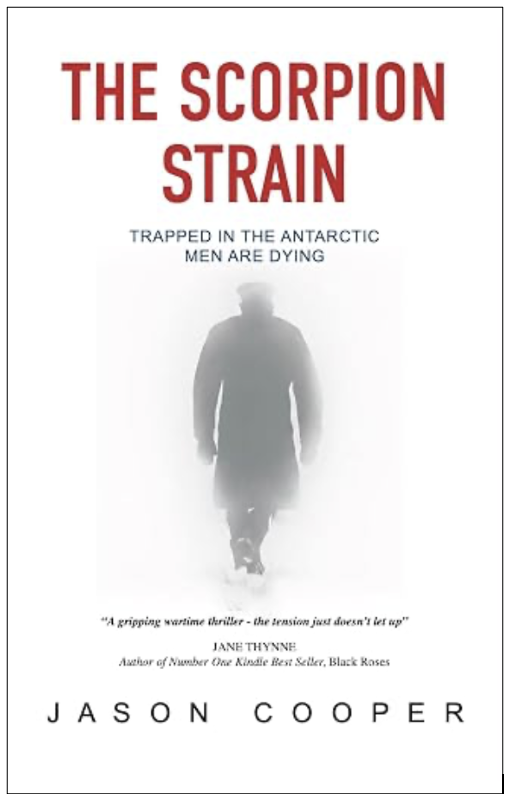
The Scorpion Strain

"A riveting page-turner that combines unforgettable characters, endless plot twists, and any number of brilliant descriptions: an arduous voyage to the Southern Ocean, a terrifying storm, and its final setting on an Antarctic station in the grip of an austral winter. I was left quite breathless and it lingered long in my mind after the last nail-biting pages"
— Chris Roche, photographer
Jason began his writing career with features for Harpers & Queen, Vogue and American House & Garden while training as a professional architect. After a spell working for a practice in California, he returned to London and worked for Arup Associates and Michael Hopkins & Partners on a wide variety of projects and international design competitions. In 1995 he opened his own practice specialising in environmental architecture and product design.
He is currently preparing his first play, Unholy Trinity, for a production in London in late 2027. He recently completed his second play, Guilt. He lives in London.
Jason traveled with his family to the Antarctic in 2006, and discovered a little-known fact: a secret British naval operation, codenamed Tabarin, was established on the Antarctic Peninsula in 1944. Intrigued by the unconvincing explanations of what Tabarin might have been, he researched the possibilities . . .

Professor James Wilson has been called upon to resurrect and lead the Achilles programme – a biological incapacitation weapon that, with its antidote, could save millions of lives.
After a harrowing voyage by ship, Wilson and his team of ten are left for eight months in the only place sufficiently cold and remote to contain its accidental release: Scorpion – a small island off the Antarctic Peninsula. By the following morning their radio has been sabotaged, and its operator is missing. The pressures on Wilson mount: already burdened by a cruel and obstructive naval team leader, Achilles eludes them, and one by one they start to die. A killer is amongst them. Should he be an enemy agent, the consequences could alter the course of the war.
-
![]()
“A tightly executed thriller which sweeps the reader to a knife-edge climax in one of the most remote places on Earth – compelling stuff"
Stephen Walker, New York Times bestselling author of Shockwave
-
![]()
"A gripping wartime adventure with a tender love affair at its core. Jason Cooper's scientific thriller is scarily plausible and the tension doesn't let up. Absorbing and much recommended"
Jane Thynne, Kindle No.1 bestselling author of Black Roses
-
![]()
“A highly absorbing and imaginative thriller that combines a thorough understanding of the science of the period with a chillingly plausible early biological warfare program – a cracking read"
Conrad Lichtenstein, molecular biologist
-
![]()
"Excellently written. Having had first-hand experience of the Southern Ocean, I found the storm sequence in particular handled with real authority – a truly authentic description of heavy-weather seafaring"
Andrew Bryant, international yachtsman
-
![]()
"I thoroughly enjoyed it: its plot, subject matter and history; the whodunnit factor, the setting, its characters – and the permanent state of tension on every page. A remarkable novel"
David Fitzherbert, entrepreneur
-
![]()
"Elegant prose and powerfully gripping narrative sweep you up in a thriller that is at once entertaining and deeply disturbing. Its wartime themes and pandemic threat speak to our times – it is a triumph"
Christopher Clement-Davies, international lawyer
-
![]()
"Once I'd started I could not stop. It kept me up all night on the edge of my bed – and right up to the last page. It is truly thrilling: a beautifully written story with pace, wonderful characters and brilliant descriptions"
Susannah Bosanquet, artist
-
![]()
"A compelling wartime thriller of murder, betrayal and revenge that twists agonizingly toward its terrific Antarctic climax – truly gripping"
Julian Pycraft, entrepreneur
-
![]()
Totally gripped, I struggled to put it down. I was rewarded right to the very end"
Dominic Warren, architect
-
![]()
"Pacy, beautifully plotted, and in a crisp, fast-flowing prose – I romped through it"
Mary Gibson, barrister
-
![]()
"An excellent novel, a great story, and a terrific read – I devoured it"
Oliver Jory, musician
-
![]()
"Gripping and finely wrought, a great story that mixes subtly-drawn characters with a vivid and punchy plotline – I loved it"
Dominic Best, filmmaker